
When Economic Empowerment Is Not Enough
Every year, before the "Women Empowerment in Armenia" program brings any income-generating activity to a funding committee, we go out.
Every time, without exception.
Our teams conduct field visits to assess feasibility on the ground, in the actual homes, actual business locations, and communities where families live. These visits exist because what looks viable on paper can look entirely different when you're standing in a 60-square-meter Soviet-era apartment with a mother who hasn't been able to work since the war ended.
Last month, March 2026, our teams visited families across the Gegharkunik, Lori, Tavush, and Vayots Dzor regions in Armenia. The same thing kept surfacing. Family after family expressed a genuine desire to do something, to build something, to earn something. And among families, there were those whose business creation conditions made it impossible to pursue any of that.
The will was there. The way was not.
Economic Empowerment for Refugees Runs Into a Wall
Economic empowerment is often presented as the central solution for displaced families. Provide skills, resources, and opportunities, and people will rebuild independence on their own terms. The logic is sound. For many refugees, it works.
But the reality on the ground is far more complex than any program framework assumes.
Through our work in Armenia, we have learned that for the most vulnerable families, economic empowerment is not always an immediate solution. And the distance between where these families stand today and where that goal lives is not measured in skills or funding alone.
One Family. One Apartment. A Deadlock.
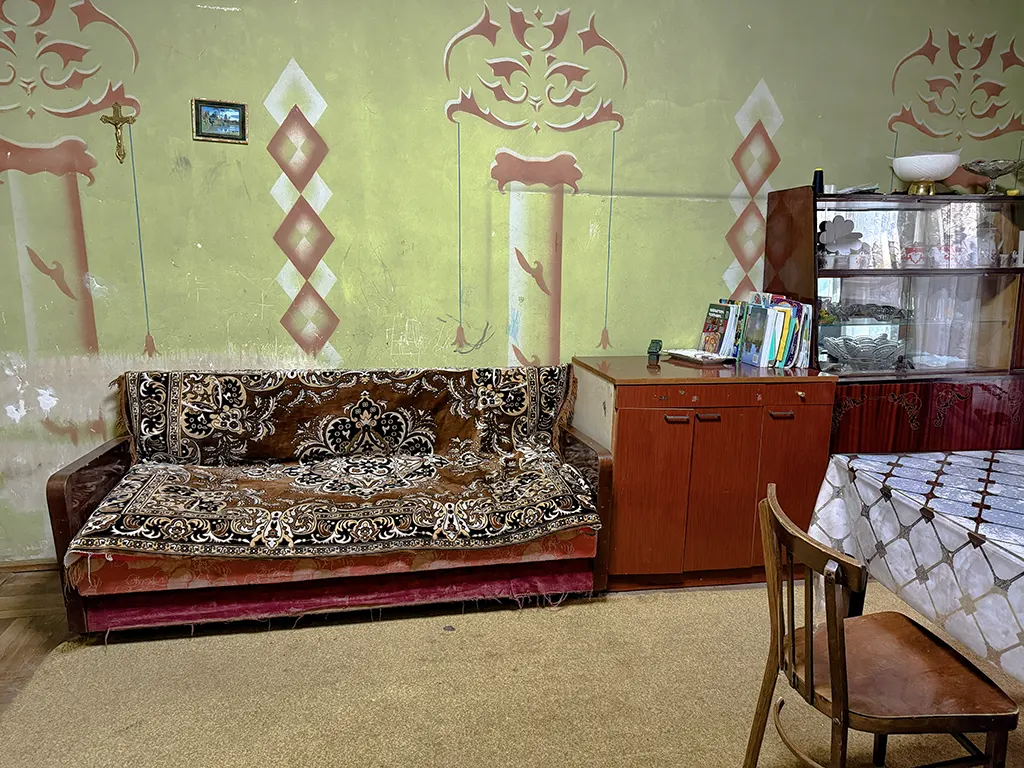
The family in Ijevan rents a 60-square-meter apartment in a Soviet-era residential building. It provides shelter. It provides nothing more. There is no space for equipment, no infrastructure, and no realistic way to develop even a small home-based business within those walls.
At first glance, solutions seem available. Training programs, small business support, and one-time financial assistance. These are the tools most programs reach for first.
In practice, each one hits a limit quickly.
The family carries significant debt accumulated during displacement. One child lives with a disability and requires constant care. The father is disabled too and walks with crutches. The mother is managing psychological trauma from the war, which makes working feel impossible on most days. Their daily life is already a struggle. There is little room left for planning, for risk, for managing even simple administrative tasks.
The neighbor's offer of a free space sounds like an opening. But the premises need substantial renovation. Without the money to cover those costs, the opening stays closed.
She has a neighbor willing to help. She has a space she could use. She even has a sense of what she wants to build. What she doesn't have is a way to start.
"I want to do something, but I don't know how or where to start. We have lost everything. Our house, our money, our savings. My son and husband are disabled, and we survive only on allowances. I am unable to work, as I have developed psychological problems after the war. A kind neighbor has offered us premises to use for free for pig farming, but they require significant renovation, which we cannot afford. I feel completely stuck. I am just waiting for the days to pass."A mother from Ijevan — refugee family, Tavush region, Armenia
Her words are not a cry of defeat. They are a precise description of a trap.
This is what a deadlock looks like.
Not a family unwilling to engage. Not a lack of motivation. A situation where every viable path forward is blocked by something real, something verifiable — something our teams witnessed firsthand during the site visit.
What looked feasible on paper collapsed the moment we arrived. We visited the premises that a neighbor had offered free of charge for pig farming. The site was located several hundred meters from Soviet-era residential blocks, in an open field, roofless, dilapidated, structurally beyond repair or renovation. Pig farming is not possible there. No alternative sites are available.
We have exhausted every option alongside the beneficiary. There is nothing left to pursue, and no path we can responsibly recommend. As difficult as it is to say, we cannot help her, not because we choose not to, but because the conditions that would make help possible simply do not exist.
The Assumption That Breaks the Program
Standard economic empowerment programs are built on a quiet assumption: the person in front of you is ready. Ready to engage, to commit, to follow through, to absorb setbacks and keep moving. That assumption is reasonable for many refugees. For the most vulnerable, it fails them entirely.
This is not a question of willingness. It is a question of impossibility. And those two things are not the same. Treating them as the same is how programs end up counting families as non-compliant, even though they are simply surviving conditions that no program was designed to address.
The barriers here are not only economic. They are social, psychological, and structural, layered atop one another in ways that no single income-generating activity can unravel.
What We Do When the Classic Approach Can't Help
When our feasibility assessment tells us that an economic project genuinely cannot move forward, we don't close the file. We change the approach entirely.
The first step is to contact social services and work with them to find solutions together. This means mapping what institutional support the family can access and making sure they are actually connected to it, not just referred to on paper.
The second step is to identify nonprofits and organizations already working on the ground in that community — organizations that specialize in disability support, psychological care, debt counseling, or emergency relief. We refer families to them directly and stay in contact to make sure the handoff is real.
What we cannot do, in good conscience, is push an economic empowerment project onto a family that has no capacity to carry it. Not because we lack the will. Because it would fail them. And because pretending a deadlock is a starting point helps no one.
What a Realistic Path Forward Looks Like
For families in this situation, the work starts somewhere quieter. A social worker who shows up consistently. A caseworker who learns what the family can actually manage and helps reduce immediate pressure through emergency support, debt navigation, or help with daily tasks that have become overwhelming.
From that foundation, something more becomes possible over time. Not a generic skills course, but vocational training matched to where the person genuinely is: their health, their schedule, the specific realities of their household. A gradual return to stability and employability. An income that goes beyond basic allowances.
Not entrepreneurship on demand. A slow, supported walk back toward the capacity to move.
What This Family Actually Needs
The mother in Ijevan is not disengaged. She is telling anyone who will listen exactly what she needs and exactly what stands in the way.
She needs a vocational pathway built around her actual life, including her son's and husband's disabilities, her own psychological recovery, and the debt that shapes every decision she tries to make.
But that pathway does not have to begin with business creation. For families in this situation, starting a business is not always the right first step. It requires capital, administrative capacity, risk tolerance, and a level of daily stability that is simply not there yet. Finally, they need physical conditions to roll out their activity.
Employment can be a better first step. Finding a job as an employee, even part-time, even in a modest role, is a legitimate and often more realistic entry point into economic independence. It provides income without the burden of entrepreneurship. It builds routine, confidence, and a track record. It creates breathing room.
What makes this possible is professional training matched to the local labor market and to what the mother can realistically manage at this stage of her recovery. Not a generic course. A skill she can build, a role she can grow into, and an employer who can offer stability while she finds her footing.
Business creation may come later, when the conditions are right. For now, earning as an employee is not a lesser path. It is a gateway, and for many women in her situation, it is the one that actually opens.
With that support, the waiting ends. The days start moving again.
That shift — from deadlock to forward motion — is what "Vulnerable Women Empowerment in Armenia" strives to make possible, even when the path is longer and harder than the program originally imagined.
How You Can Help
The families who fall between program categories are often the hardest to reach and the costliest to support well. They need more time, more individual attention, and more flexibility than standard funding models allow.
What this family's case makes clear is that there is no single formula. Each family requires its own approach, its own timeline, and its own combination of support. That takes time. It takes sustained attention. And it takes resources.
This is why Arev Society and the Armenian Fund for Sustainable Development also need support. Not to run programs at scale, but to show up, case by case, for as long as it takes.
No one should be left behind just because their situation doesn't fit the template.