
Digital Inequality in Armenia
At Arev Society, we believe that true digital transformation must leave no one behind. Through our Digital Literacy Initiative for Vulnerable Women, launched in June 2024, we've witnessed firsthand how targeted education can transform lives.
Understanding Digital Inequality: Beyond Access to Skills
Digital literacy is an individual's ability to find, evaluate, and communicate information using digital platforms. It combines technical and cognitive abilities to create, evaluate, and share information effectively.
Due to the digital divide, numerous individuals are deprived of the chance to provide a stable income for their families, breaking the cycle of poverty despite meeting job requirements or having an appropriate education.
Reality of Digital Divide in Armenia
Armenia has approximately 2.18 million internet users, constituting 78.6% of the population, with 66.6% being social media users (1.4 million Facebook and 1.01 million Instagram users).
However, this connectivity masks deeper challenges. While most vulnerable women are active internet and social media users, only some can correctly:
- Fill out electronic forms
- Write professional resumes
- Find necessary information to prepare business plans
- Navigate online job applications
Current digital gaps reveal significant disparities: Only 35% of women possess basic digital skills compared to 55% of men, with much lower internet access in rural areas.
The Gap in Current Educational Offerings
While the Armenian government has digitalization efforts planned for 2026-2030, these initiatives primarily target professional sectors and lack adaptation for vulnerable populations needing lifelong learning support.
Numerous tech courses exist in Armenia, but their distribution is unfair and inadequately specialized for vulnerable groups. They're often not "user-friendly," and information is communicated through portals that are inaccessible to targeted groups.
Many potential applicants become discouraged when encountering complex applications via email or Google Forms, as they prefer using the internet for leisure rather than developing basic digital skills.
Arev Society's Digital Literacy Initiative: A Targeted Solution
Recognizing these gaps, Arev Society, in collaboration with the Armenian Fund for Sustainable Development, launched in June 2024 the "Digital Literacy Initiative for Vulnerable Women" program targeting vulnerable refugee women and war victims.
Digital Literacy Course
Our Digital Literacy course equips our beneficiaries with the practical digital skills needed to navigate today's world with confidence. Participants learn to use Microsoft Office (Word, Excel) and Google Workspace (Docs, Sheets, Slides, Gmail) for everyday tasks, master safe internet practices like data protection and secure communication, and apply these skills to job searching and daily work. The course moves participants through four stages: first learning the tools, applying them in practice, using them on real tasks and collaborative projects, and building the confidence and independence needed to meet today's labor market demands.
Our Program Journey
June 2024: Launched the first Digital Literacy course.
February 2025: Organized the second enhanced cohort based on participant feedback.
June 2025: Conducted the third cohort with an improved curriculum.
October 2025: Digital Literacy Fourth Session gathered 100 participants.
February 2026: Directed the fifth Digital Literacy cohort with updated practical exercises.
May 2026: Digital Literacy Sixth Session successfully graduated another high-performing group of learners.
August 2026: Seventh cohort with an updated curriculum.
AI courses for Vulnerable Women
In 2025, two separate courses were organized on the use of generative AI tools for enhancing employment skills. Courses encompassed the use of ChatGPT, Claude, Gemini, Perplexity, Gamma, and others.
After each session, we conducted comprehensive assessments among beneficiaries, and the findings were consistently positive, leading to the expansion of the program.
Our Program Journey
January 2025: Launched the first Artificial Intelligence course.
November 2025: Organized the second AI cohort based on participant feedback.
February 2026: Conducted the third AI cohort with an improved curriculum.
May 2026: Fourth AI session gathered another group of engaged learners.
July 2026: Directed the fifth AI cohort with updated practical exercises and tools.
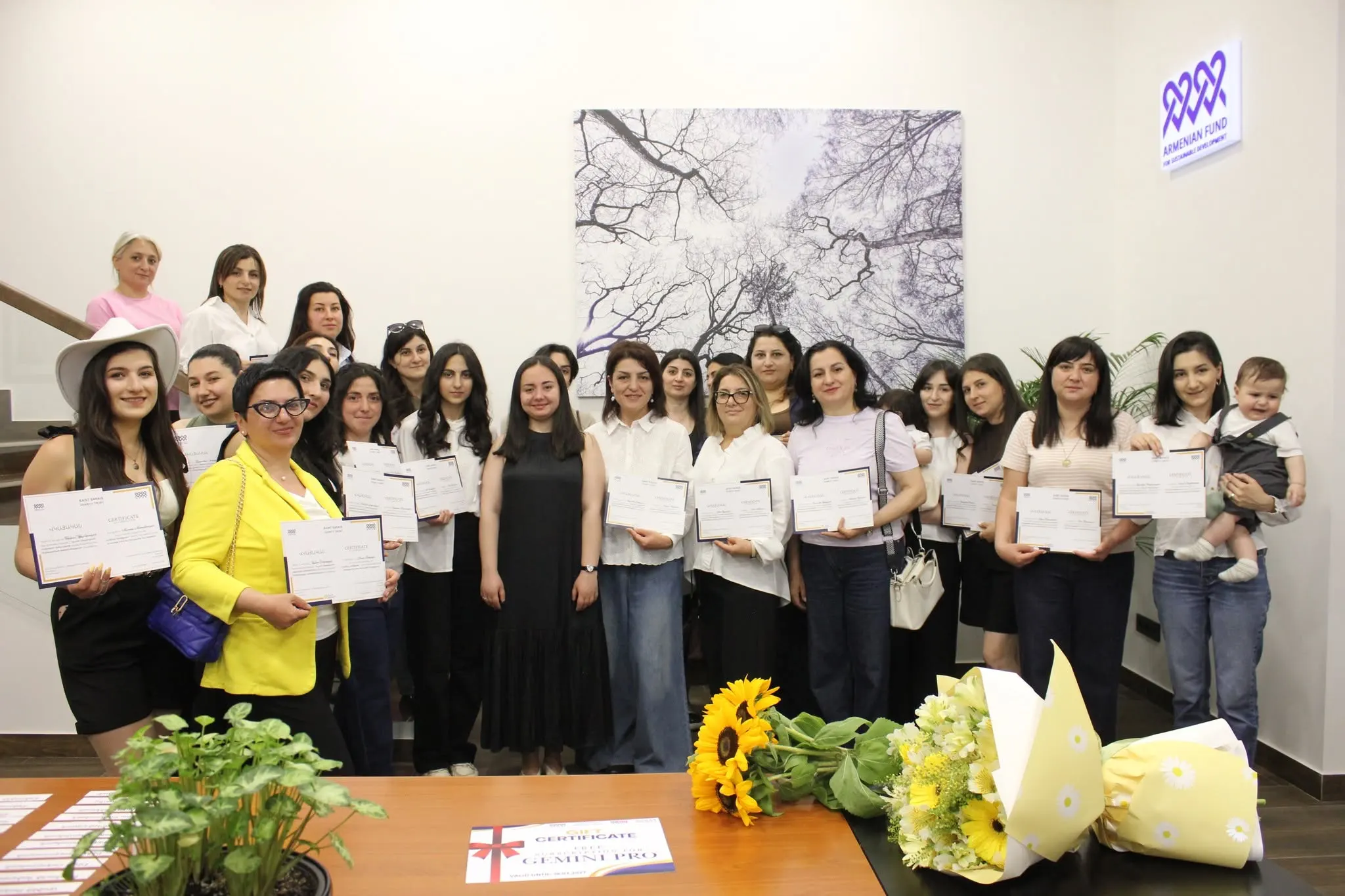
Graduates of an AI course cohort receiving their certificates in Yerevan.
Aligning with Global Goals
Our work supports the UN Global Digital Compact, adopted September 22, 2024, which emphasizes that "technology benefits everyone" with a commitment to fairness and inclusivity.
According to UN studies, achieving inclusive digitalization requires comprehensive approaches that address not just infrastructure but also human capacity building, exactly what our targeted programs provide.
Digital transformation must be inclusive
Our successful cohorts prove that when digital education is designed with vulnerable populations in mind, transformative results are possible.
The knowledge participants gain enables them to make informed and confident decisions about their future, thereby improving educational prospects, enhancing employment opportunities, and facilitating small business creation.
What is next?
Arev Society and AF4SD built this program from the ground up, and two years of results prove the model works.
Now, our main focus is building a secure digital empowerment platform where every woman has her own learning environment: skills assessment, a personalized pathway, connection with peers and mentors, and a certificate based on demonstrated competency, working toward national accreditation that gives graduates a credential with real labor-market value.
The goal isn't to replace what's working. It's to give a proven model and a refugee-led outreach partnership the infrastructure to reach thousands instead of hundreds. We were looking for an organization driven by refugee needs, not by political or other motivations, and we found Dizak, a nonprofit whose founders were themselves displaced from Artsakh.
Together we will find and support the people who are hardest to reach and who need this training the most.
Help Us Build the Infrastructure
Two years of evidence. A model that works. Now, with outreach and the right infrastructure, we can reach thousands more.