A professional career can disappear much faster than we imagine.
Sometimes it happens because of war. Sometimes because a family has to leave its home. Sometimes because years of uncertainty make a woman stop believing that her experience still has value.
For many women displaced from Artsakh (Nagorno-Karabakh), rebuilding life in Armenia meant much more than finding a new place to live. It meant starting again.
A new city. A new labor market. New employers. New expectations.
And, for many, a professional identity that no longer felt clear.
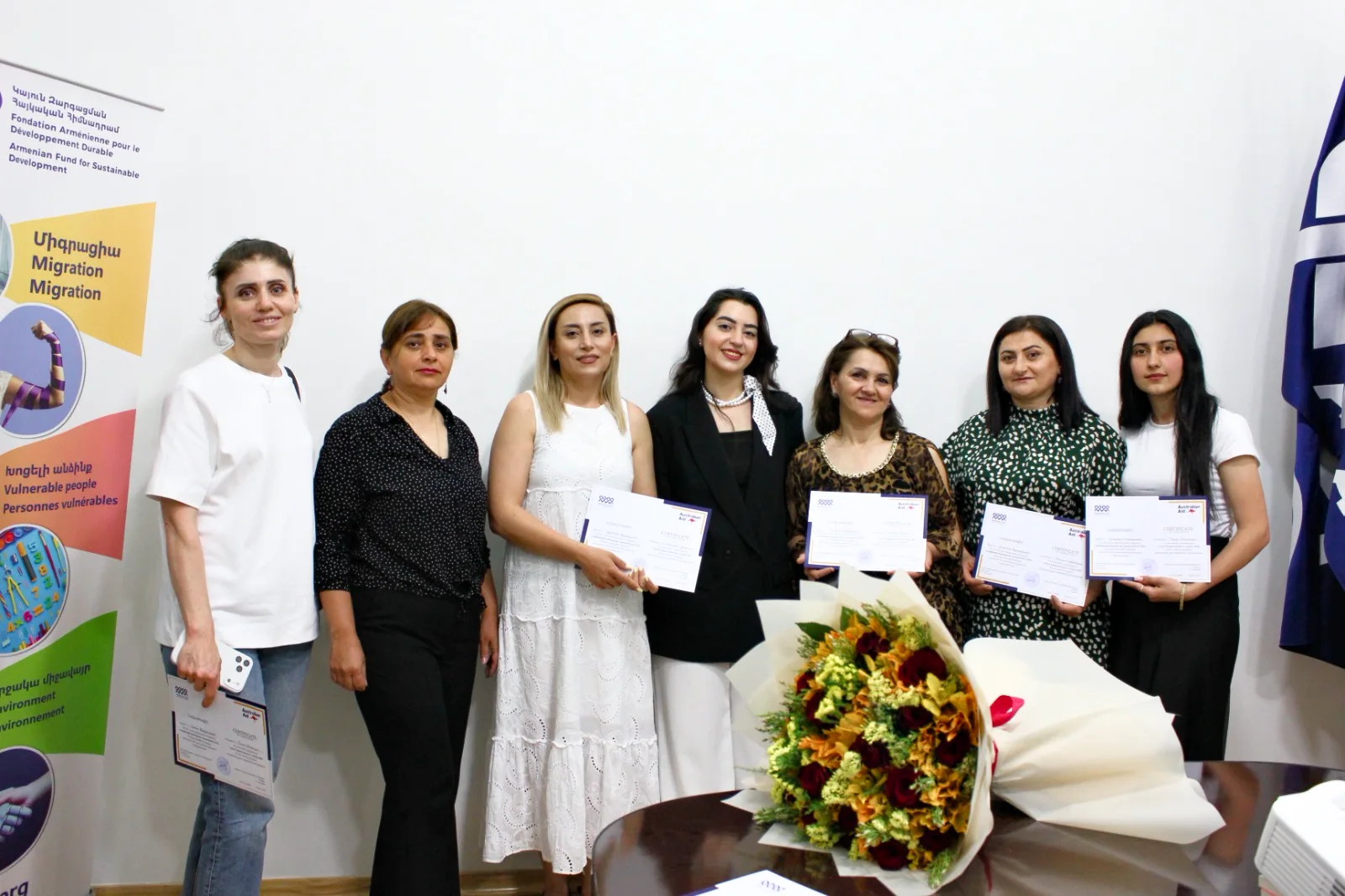
The women who joined the Career Empowerment Training Course did not simply need help writing a CV. Many already had years of experience, responsibilities, knowledge and skills.
But displacement had interrupted their careers and professional networks. Some were unfamiliar with the Armenian recruitment market. Others had been outside formal employment for years. Fear of rejection and uncertainty about their own abilities made the first step even harder.
“I don't have enough experience.” “No employer will hire me.” “I don't have valuable skills.”Thoughts some participants arrived with
These sentences may sound simple. But behind them are years of interrupted plans, uncertainty and having to rebuild life from the beginning.
The course was therefore designed around a simple idea:
Before we can help someone enter the labor market, we sometimes have to help them see their own value again.
This approach reflects a wider commitment within our women's empowerment work: moving beyond short-term assistance toward skills, economic independence and sustainable opportunities.
Rediscovering Skills That Were Always There
The course combined three elements: personal empowerment, career development and practical application.
Participants explored their strengths, values and transferable skills. They learned how to understand the Armenian labor market, identify opportunities, prepare professional documents, use LinkedIn, communicate with employers and approach interviews with greater confidence.
One of the most important discoveries was that a woman does not need to have worked in a large company for her experience to have value.
Managing a household requires organization. Raising children requires responsibility, adaptability and problem-solving. Volunteering requires communication and initiative. Surviving displacement requires an extraordinary ability to adapt to uncertainty.
Informal work and community responsibilities can build skills that employers value, if someone knows how to recognize and communicate them.
That became central to the work: turning experiences that once looked like gaps into strengths that employers could recognize as professional assets.
What Changed for the Participants
Forty-eight women took part in the course. At the start, 69% had no prepared CV, 94% had no LinkedIn presence, and most had been searching for work on their own for more than six months.
By the end of the course, all 48 participants left with a professional, market-ready CV. Among the participants who completed the end-of-course survey, 57% had built active LinkedIn profiles, 86% reported stronger networking skills, 71% reported better job-search and application skills, and 43% felt more confident about salary negotiation and goal setting.
From no CV to a market-ready profile
Share of participants (%) at the start and at the end of the course
31 percent of participants had a CV at the start and 100 percent at the end. 6 percent had a LinkedIn presence at the start and 57 percent had an active profile at the end. At the end, 86 percent reported stronger networking skills, 71 percent better job-search skills and 43 percent more confidence about salary negotiation.
View the data
| At the start | At the end of the course | |
|---|---|---|
| Professional CV | 31% | 100% |
| LinkedIn profile | 6% | 57% |
| Stronger networking skills | – | 86% |
| Better job-search skills | – | 71% |
| More confident negotiating salary | – | 43% |
After the course, participants' employment status was as follows: 31% were employed full-time, 25% were employed part-time, and 6% were self-employed, while 6% were students and 31% were unemployed.
Where participants stood after the course
Employment status after the course (% of participants)
After the course, 31 percent were employed full-time, 25 percent part-time, 6 percent self-employed, 6 percent students and 31 percent unemployed.
View the data
| Participants | |
|---|---|
| Employed full-time | 31% |
| Employed part-time | 25% |
| Self-employed | 6% |
| Student | 6% |
| Unemployed | 31% |
Behind the Numbers
The numbers tell only part of the story.
One participant used the course to begin planning the path toward her long-term goal of opening her own private school.
Another used an “elimination principle” to explore different career directions, gradually narrowing her options until she identified the sector she wanted to pursue.
For another, the knowledge and practical tools she gained helped her approach her career with more purpose and move more confidently toward her goals.
For others, the change began at an even deeper level: building self-confidence, developing resilience and learning not to give up when facing difficulties.
When One Woman's Learning Reaches a Classroom
One of the most meaningful stories came after the training itself.
One of our participants later began teaching at a college. She shared what she had learned in the course with her students. Then her students started coming back to her. Some told her that the knowledge she had passed on helped them find jobs. One student went on to start her own business.
Suddenly, one woman's learning no longer stayed with one woman.
It moved from a participant to a classroom. From a classroom to students. From students to jobs and entrepreneurship.
This is what sustainable empowerment can look like.
The most important lesson from this program is this:
A woman may lose her home, her network, her position or years of her career. But with the right support, she does not have to lose her sense of what she can become.
Note: This article presents mid-term highlights from the Career Empowerment Training Course, a component of the Women's Economic and Career Empowerment Project, supported by the Australian Government through the Direct Aid Program (DAP) and implemented by the Armenian Fund for Sustainable Development. The course aims to train at least 100 women across four cohorts and offers participants up to three months of career coaching and job placement support after completing the training. Arev Society provides management support for the overall Women Empowerment Program and leads its communication and visibility efforts, helping to extend the program's reach.
Disclaimer: This article is published by Arev Society for information and awareness purposes only. The views and interpretations expressed are those of Arev Society alone and do not necessarily reflect the official positions of the Direct Aid Program (DAP). The DAP has not reviewed or endorsed this article. The figures presented are drawn from the course's internal participant surveys and were accurate to the best of our knowledge at the time of publication. As these are mid-term results, we may update the figures as the program continues. Arev Society accepts no responsibility for errors, omissions, or decisions made on the basis of this content. Participant stories are shared with their consent, and we have withheld names to protect their privacy.